-1.png?width=226&height=39&name=Servitalent_logo%20lado%20(2)-1.png "Logo Servitalent")

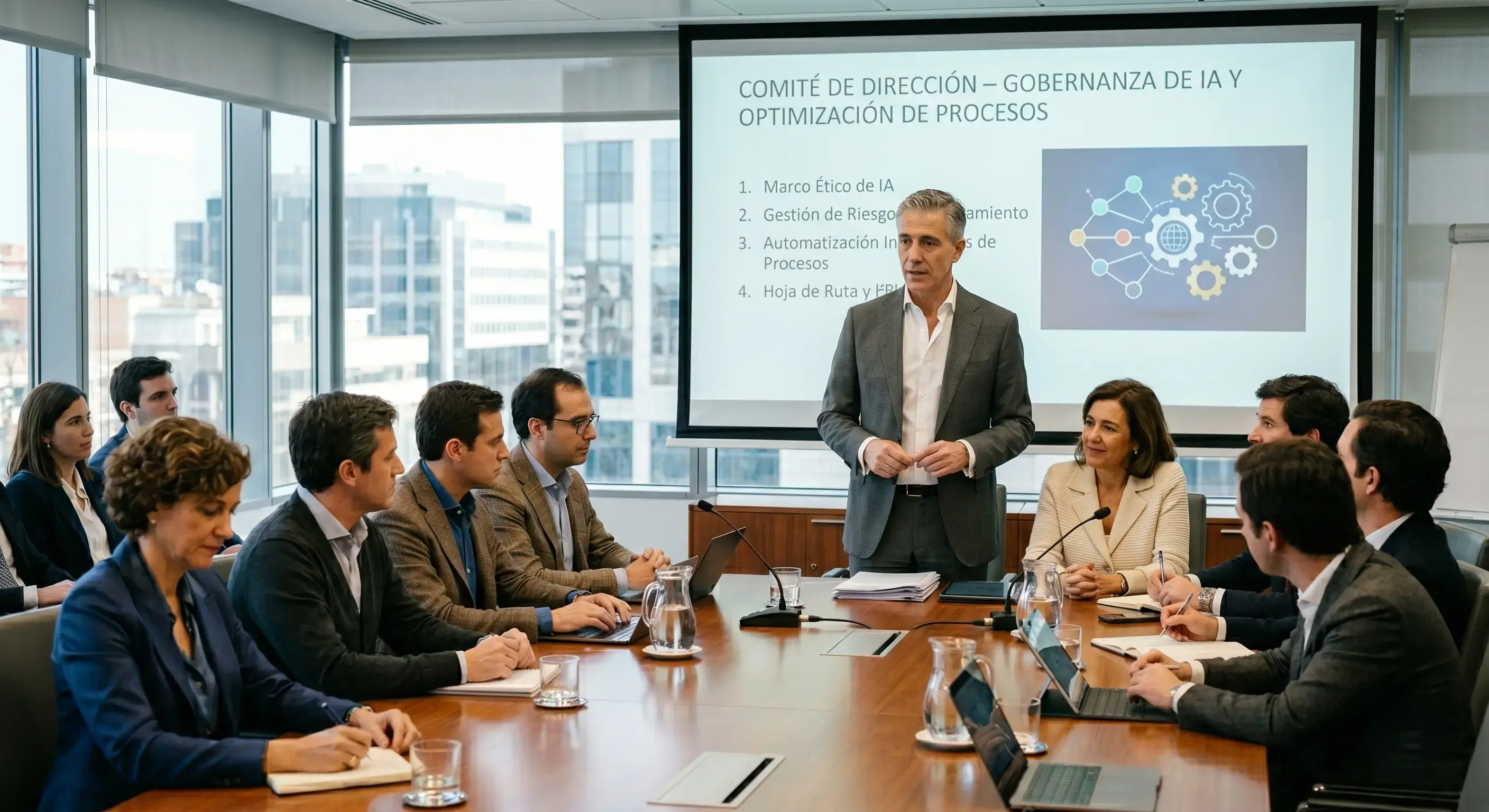
For the past two years, virtually no board of directors has been able to avoid putting an item on its agenda regarding artificial intelligence. And yet, most organizations remain stuck in the same place: they know they have to take action, they’ve run a few pilot projects, they’ve purchased a few licenses, and the topic resurfaces at the next meeting without any real progress having been made.
The problem isn’t one of understanding. It’s one of execution.
The critical gap between strategic decision and reality
Official reports from the National Institute of Statistics (INE) reveal that barely 13.8% of companies with more than 10 employees in Spain have integrated Artificial Intelligence tools into their actual operations. The gap between media hype and daily practice cannot be explained solely by budget constraints or a lack of technology. It is largely due to a lack of governance and internal executive capacity.
The implementation of interim management and AI solutions demonstrates that technology is no longer a matter to be delegated to the CTO nor a problem solved with a standalone innovation budget. It directly affects your business strategy, operating margins, HR processes, legal risk management, and corporate culture itself.
The European AI Regulation is now fully in effect, and its legal obligations will be phased in between 2025 and 2026. Given this scenario, the question your Board of Directors must ask is no longer “Should we do something about AI?” but rather “Who in our organization has the clear mandate, practical experience, and actual availability to execute this right now?”
Do you need someone to help you lead this technological transition?

Why your current internal team isn’t enough for this challenge
This isn’t about questioning the high caliber of your current leadership team. It’s about being honest about what it takes to lead an organizational transformation of this magnitude in your day-to-day operations.
Integrating technology into an industrial or service operating model is not a side project that can be delegated without consequences. It requires:
- Building from scratch a critical inventory of tools and security risks.
- Designing a robust corporate policy for governance and algorithmic control.
- Establishing strict criteria for use, human oversight, and vendor evaluation.
- Managing cultural change and employeetraining .
All of this must happen while the business continues to generate revenue, customers continue to demand attention, and your team is already overwhelmed with operational workload.
Internal executives, moreover, bear the burden of pre-established relationships, historical consensus, and the day-to-day inertia of the organization. True transformation often requires an external perspective that can speak the truth without filters, prioritize resources without fear of internal political consequences, and move at a pace that the company’s usual rhythm does not allow.
The Interim Manager: Executive leadership for a critical window of opportunity
The transitional management is a model that has been operating successfully in Europe for decades to address precisely these types of scenarios: when a company needs to execute a complex and urgent project but cannot wait for a lengthy traditional selection process or overburden its internal resources.
A high-levelinterim manager, specializing in digital transformation processes, brings two unique strengths that no external consultant or in-house resource possesses simultaneously: immediate hands-on expertise, true integration into your executive committee, and direct accountability for results.
This professional doesn’t come to write a report with recommendations; they come to make decisions and execute the plan.
In the context of AI integration, the role of this interim leader adapts to your organization’s maturity level:
- Interim Chief AI Officer: Designs the governance policy from scratch and establishes the framework before leaving.
- Interim Director of Operations: Leads the automation of key processes and delivers measurable improvements within six to twelve months.
- Transformation Director: Has a cross-functional mandate to align business, technology, legal, and people under a single, coherent roadmap.
The key difference between this model and traditional consulting is that the interim manager sits at your table, makes executive decisions, manages your teams, and assumes contractual responsibility for getting things done. When their assignment ends, they leave the operational capabilities in place within your workforce—not tasks still waiting to be implemented.
The tough questions your Board of Directors must ask itself today
Any viable business strategy requires an honest, no-nonsense assessment:
- Does your company have a true inventory of which AI tools are being used, including those your staff uses without authorization (Shadow AI)?
- Do you have a compliance policy that distinguishes between permitted uses of AI and those that are sensitive or prohibited under European regulations?
- Is there anyone in the organization with a clear mandate to take responsibility—both legally and in terms of reputation—if an automated system makes a critical error?
- Does the Board know what data feeds the algorithms already in operation and whether there is actual human oversight of them?
If the answer to most of these questions is “no” or “in progress,” your organization has a very dangerous execution gap. And that operational gap immediately translates into regulatory costs, a loss of competitiveness in the market, and unacceptable reputational risks.
The competitive window is closing
Technology isn’t going to wait for your management team to have free time. Your direct competitors, who are already integrating advanced tools into their value chains, aren’t going to slow down. The European legal framework will soon require evidence of governance that many industrial organizations today wouldn’t know how to present during an audit.
Your Board has the responsibility to assess not only whether the theoretical AI strategy is sound, but also whether the company has the actual executive capacity to put it into practice on the ground.
In most cases, the fastest and most cost-effective solution is to temporarily bring in senior leadership from outside the company: a professional with proven experience, who integrates fully into your team and whose mandate is focused exclusively on delivering results.
That’s what an interim manager does. And in today’s business landscape, few corporate decisions will
Do you want to implement AI without overburdening your team?