-1.png?width=226&height=39&name=Servitalent_logo%20lado%20(2)-1.png "Logo Servitalent")


In day-to-day talent management, there is a constantly recurring scene in general management and human resources: a strategic position becomes vacant and the dilemma of who to choose for the position arises. Historically, companies have grappled with a critical blind spot in these processes: the huge gap between what a candidate claims in an interview and his or her actual performance in the work environment.
Resorting to "eyeballing" to assess potential, basing decisions on personal affinities, loyalties or intuitions, is an unacceptable risk. To ensure success in talent assessment, leading companies rely on a structured, data-driven tool: the executive assessment.
In the following, we will explore exactly what this service consists of, what its many strategic applications are, and how to implement it to ensure that the leadership team is prepared for today's challenges.
What is management assessment.
The end of the ogmeter
A management assessment is a comprehensive diagnostic process designed to objectively and accurately evaluate the competencies, attitudes, values and soft skills of managers and middle managers as applied to the organizational environment.
Unlike a traditional interview that measures technical knowledge (the "what"), the assessment measures underlying behavior and leadership potential (the "how"). Leadership turnover can cost an industrial company up to 2.5 times the manager's annual salary due to hiring mistakes or lack of cultural fit.
360-degree methodology: the core of objectivity
The driving force behind the reliability of a modern assessment is the 360-degree assessment. By combining the individual's self-assessment with the perception of his or her professional environment (superiors, peers and collaborators), a balanced view is obtained:
- Drasticallyreduces the weight of individual opinion.
- Avoids cognitive biases in internal promotion.
- Increases the perception of fairness and meritocracy within the company.
8 strategic use cases of assessment
The executive assessment is a versatile tool that accompanies the entire life cycle of the professional.
1- Executive search and talent selection.
It allows to validate the "competency fit" by comparing the candidate with the success model required for the position, reducing the risk of a bad recruitment.
2- Internal promotion
Acts as an objective arbitration between several in-house candidates, ensuring a managerial decision.
3- Leadership development
Confronts the leader's self-perception with the real vision of his team to identify "blind spots" and design precise development plans.
4- Succession planning
Detects in advance if potential successors are prepared to assume C-Level positions, minimizing strategic risks.
5- Targeted Onboarding
It serves to design customized onboarding plans that accelerate the productivity of the new employee from day one.
6- Talent retention (high potentials)
Identifies critical profiles to create attractive career plans that shield key talent from competition.
7- Culture and climate audit
Measures cross-functional competencies across entire teams to reduce operational friction and improve the work environment.
8- Team assessment in industrial startups
Evaluates the maturity and strategic leadership capacity of foundational teams in professionalized scaling processes.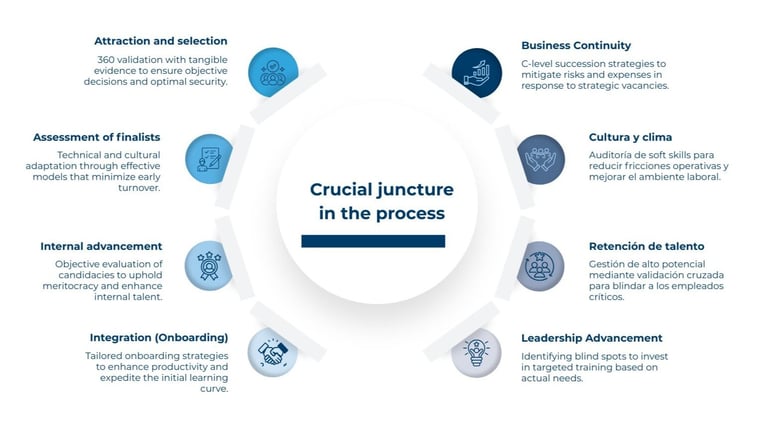
How to perform a management assessment step by step
For an assessment to yield valuable data for decision making, it is necessary to follow a rigorous methodology. At Servitalent, supported by advanced digital tools such as Steelter®, we structure the process as follows:
Phase I: Preparation and diagnosis
The key competencies and success profile are defined through an initial meeting with the client.It is essential to establish the specific assessment criteria before starting the measurement.
Phase II: Individual and group evaluation
In this stage, various tests adapted to the managerial profile are applied:
- Psychometric evaluation: Analysis of aptitudes using certified tools.
- 360º Collection: Obtaining feedback from superiors, peers and subordinates.
- Competency-based interviews: Structured sessions to deepen the observed behaviors.
Phase III: Talent analysis and feedback
Data is consolidated to generate individual and group reports.These documents highlight strengths, areas for improvement and development potential.The process culminates with feedback sessions to establish concrete action plans.
The future of your organization depends on the quality of your leaders.
Implementing a management assessment has ceased to be a luxury and has become the standard for industrial companies looking to scale with confidence. By basing strategic decisions on objective analytics, organizations not only improve their competitiveness, but also build cultures that are more resilient and prepared for the challenges of the future.
Do you need to assess the real potential of your teams to face new challenges?

.png?width=400&name=Publicaciones%20blog%20(44).png)